A sofa that sleeps someone is the most common answer to the guest-bed problem, and it is the category where the specification that decides everything is the one almost no listing publishes. Every sofa tells you its closed dimensions. Very few tell you how deep it is when somebody is asleep on it, and that is the number that determines whether the thing works in your room.
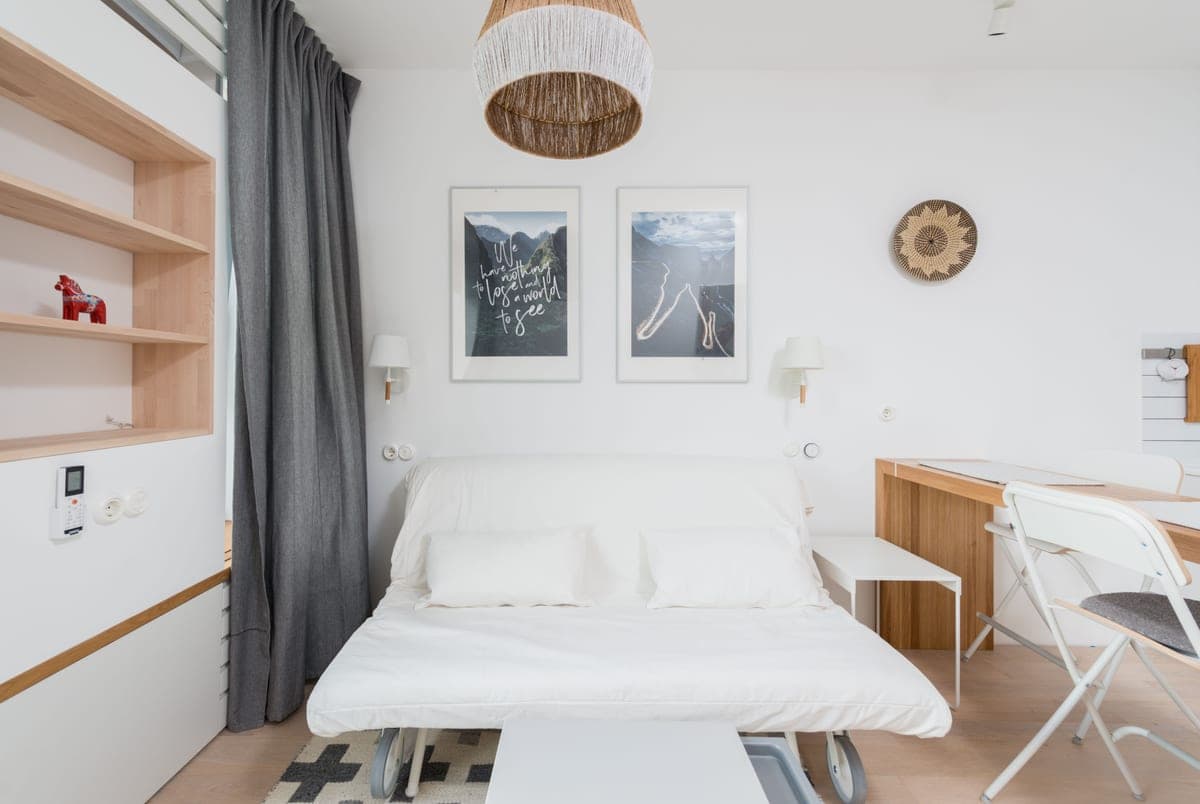
The category divides three ways by mechanism, and the mechanism decides the floor space far more than the model does. A split-back folds its own backrest down in two independent halves — nothing slides, nothing lifts, and the sofa’s own wood frame carries the sleeper, which is why published capacities of 600 pounds are normal. A click-clack does the same thing with a single one-piece back, which lets the frame be narrower; the Serta Rane at 66.1 inches is the smallest thing we cover. A pull-out has a separate steel frame and folding mattress that travel forward out of the sofa body, which is the most comfortable arrangement and needs 70 to 90 inches of projection from the wall.
Depth gain when opened — the figure the listings skip
- Serta Rane (click-clack)
- 33.1 in. to 37.6 in. — gains 4.5 in.
- Novogratz Brittany (split-back)
- 34.5 in. to 43.5 in. — gains 9 in.
- DHP Emily (split-back)
- 34 in. to 43.5 in. — gains 9.5 in.
- Novogratz Tallulah (split-back)
- 33.5 in. to 44 in. — gains 10.5 in.
- PUREMIND (pull-out)
- extends to 71.7 in. deep open
What decides price in this category is mostly the mattress and the documentation rather than the frame. At the bottom you get a wood frame, foam fill, a three-position back, a published capacity of 400 to 600 pounds, and — often — no stated open dimensions at all, which is a real cost because you cannot plan a room from the listing. Moving up buys you a thicker or memory-foam seat, a longer open surface, and a manufacturer who publishes the numbers. Above that you start buying a genuine mattress: either a pull-out with a real folding mattress, or a futon frame with an eight-inch pocket-coil mattress on it.
The mistake buyers make is measuring the wall and not the floor. A sofa that fits the wall perfectly can still be unusable if opening it leaves eleven inches between the mattress and the coffee table — and the coffee table is what blocks the bed in nine out of ten small rooms. The second mistake is assuming these open to standard mattress sizes. They do not: a Novogratz Brittany opens to 70.5 by 43.5 inches, a Serta Rane to 66.1 by 37.6, and no fitted sheet is made for either.
If someone is going to sleep in the room more than about six or eight nights a month, a convertible sofa is the wrong tool and we would rather say so. The surface is a compromise in a way a mattress is not, and the fold seam does not stop being there. For that pattern of use look at a wall bed or cabinet bed, or a daybed if the room can accept a bed in it permanently.