
Skip to content

Guides / Reference

What Size Mattress for a Daybed?

A twin, almost always. The part that catches people is not the width and the length — it is the depth limit, and the fact that a trundle has a different one.

The short answer

A standard daybed takes a twin mattress: 38 by 75 inches. Full, queen and twin-to-king daybeds each take their own size, so read the frame rather than the category. Twin XL at 38 by 80 inches will not fit a frame cut for 75 inches. Depth is the second constraint — frames in our registry publish limits of 6 to 8 inches, and a pull-out trundle tray is shallower than the daybed above it.

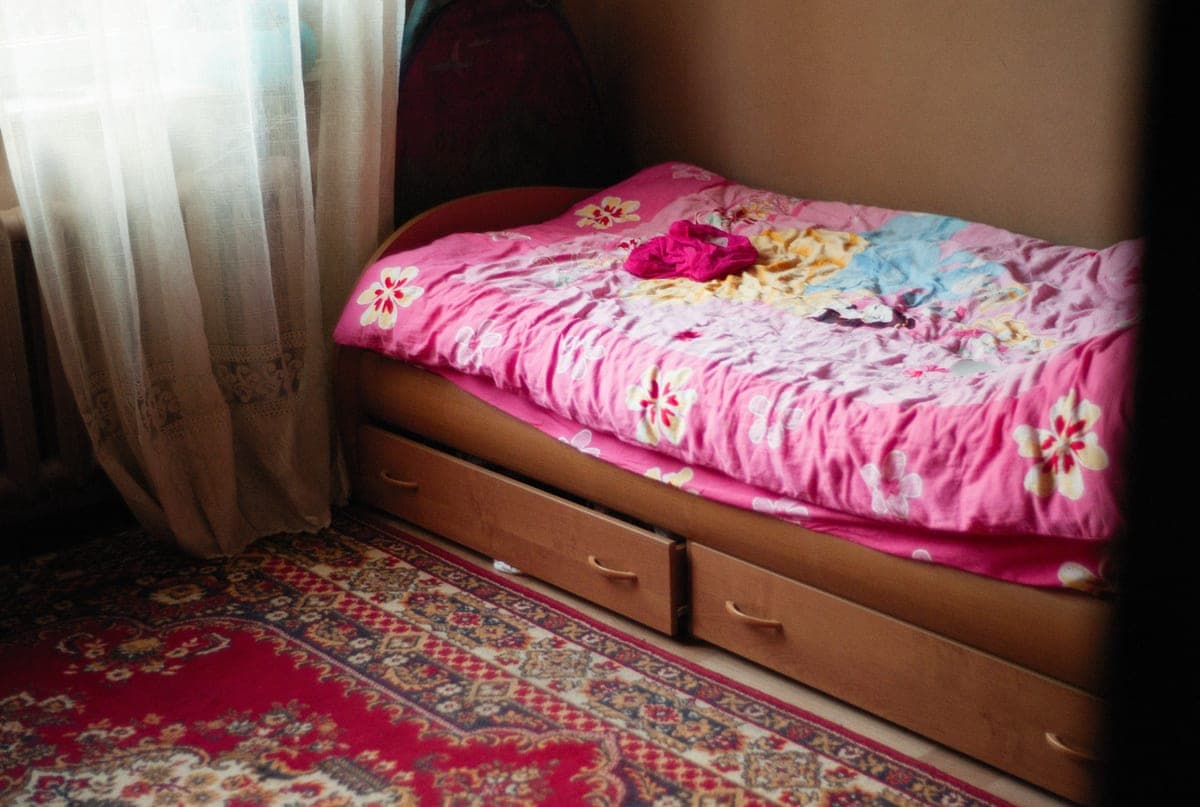
A low bed with a pull-out trundle drawer beneath it on a bare floor

The width and length are the easy part and almost nobody gets them wrong. A daybed is built around a specific mattress size and the listing states it: twin for most, full or queen for the larger frames, two twins for anything with a trundle.

What catches people is depth. A daybed has side rails, and the rails cap how thick a mattress can be before the bed stops looking like seating and starts looking like a mattress balanced on a frame. Several manufacturers publish that limit, and a pull-out trundle has a tighter one than the daybed it slides under.

The sizes, and which one your frame takes

Standard mattress sizes, and the daybed frames that take them

Twin — 38 × 75 in.
The default. Most daybeds and most trundles.
Twin XL — 38 × 80 in.
Will NOT fit a frame cut for 75 in. Five inches too long.
Full — 54 × 75 in.
Full daybeds, and the trundle under a queen/full frame.
Queen — 60 × 80 in.
Queen daybeds only — e.g. the DHP Manila queen/full.
Two twins side by side — 76 × 75 in.
Pop-up trundle frames, raised level.
Standard king, for comparison — 76 × 80 in.
King width, five inches longer.

That last pair is worth dwelling on if you are buying a twin-to-king pop-up trundle daybed. Two standard twins side by side give you 76 by 75 inches, which is king width and five inches short of a king’s length. King sheets will not fit it properly, and the frames that claim to convert to a king are honest about the width and quiet about the length. Detail in the best daybeds that convert to a king.

Frames in our registry, by what they take: the DHP Manila twin and the Novogratz Bushwick take two standard twins; the Novogratz Bright Pop takes one full plus one twin; the DHP Manila queen/full takes a queen with a full trundle; the DHP Kayden, Bellemave and JULYFOX take one twin each.

Depth is the specification that actually constrains you

This is the number to look for and it is often buried. The side rails on a daybed are typically 40 to 42 inches high at the back and rather lower at the ends, and a mattress deeper than the rails allow sits proud of the frame — which looks wrong and, more practically, makes the back rail useless to lean against.

Published depth limits in our registry

Novogratz Bushwick
8 in. maximum, stated by the manufacturer
Dream Solutions twin + pop-up trundle
8 in. maximum, mattresses included
Costway extendable twin to king
6 in. recommended by the manufacturer
ONBRILL twin + pop-up trundle
Maximum thickness not stated
Deolme twin to king
Maximum thickness not stated
A twin bed frame, for comparison
No limit — 10 to 12 in. is available to you

Six to eight inches is the working range, and eight is the most generous figure anyone we cover publishes. If the frame states nothing, measure from the slats to the top of the side rail and buy a mattress an inch or two under that.

This limit is the real cost of choosing a daybed over a plain twin bed, and we say so plainly in daybed vs twin bed: an open twin frame will take a 10-to-12-inch mattress, which is a better sleeping surface than any daybed can accept.

The trundle takes a shallower mattress than the daybed

This is the single most common mistake in this category: buying two identical mattresses for a daybed and trundle set. The tray that rolls underneath is shallow by necessity — the Novogratz Bushwick’s trundle is 3.5 inches deep as a tray — and the mattress on it has to clear the underside of the daybed when it rolls in.

Six inches is the practical ceiling on a roll-out trundle. Eight will usually go in and then scrape, and you will discover that the first time somebody tries to put it away in the dark.

Pop-up trundles are different and this is their main advantage. A pop-up tray lifts level with the daybed rather than staying low, so both surfaces end up at the same height and the depth rule relaxes toward the frame’s own limit. The Dream Solutions set works this way and publishes an 8-inch maximum for both.

Also read both capacity figures, not one. A trundle is almost always rated lower than the bed above it — the Bushwick is 400 lb on top and 250 lb below — and the lower number is the one that matters. The ranked set is in the best daybeds with a trundle.

Which construction suits a daybed

Within a 6-to-8-inch budget there are three real choices, and the right one depends on whether the daybed is also seating.

Eight inches of memory foam is the sensible default for a daybed that mainly sleeps people: two inches of memory foam over two of comfort foam over a four-inch high-density base, inside the 8-inch limit, no box spring needed on slats. One figure to check is the twin capacity — the Zinus eight-inch is rated 250 lb in twin against 500 lb in every larger size, and twin is what a daybed takes. For a heavier sleeper a coil build is the sounder choice.

Six inches of innerspring is firmer, which is better if the daybed is seating for most of its life. Foam compresses under a seated load at the front edge; coils push back. It is also the depth that fits a roll-out trundle tray.

A tri-fold makes sense when the second surface is occasional. Seventy-five by 31 by 6 inches flat and 31 by 25 by 18 inches folded — cot width rather than twin width, which is the honest catch, but it stores in a cupboard and costs nothing to keep.

The ranked comparison of all three is in the best daybed mattresses, and if you want the bed made up on arrival, daybeds with the mattress included tells you what is actually in the box.

Sheets and bolsters

Standard twin sheets fit a 38 by 75 inch daybed mattress normally. The thing to buy deliberately is the bolster: one firm upholstery-grade foam bolster, 16 to 20 inches deep and the full length of the back, is what turns a daybed into something you can sit back on. Fiber fill collapses and will not do it.

Some links on this page are affiliate links. If you buy through one we may earn a commission at no extra cost to you, and it does not change what we recommend or how we rank it. Full disclosure.

At a glance

The mattresses that fit these limits

Tap any row to jump to the full write-up. Scores are our own, from the rubric on how we choose — not customer ratings. They score each product across the whole site, so the order here reflects how well a pick answers this page’s question, which is not always the same as the highest score.

#ProductBest forScorePrice
01
A small guest bedroom with a neatly made bed against a pale wallIllustrative

Zinus 8 Inch Green Tea Memory Foam Mattress

Two inches of memory foam, two of comfort foam, four of base — the standard answer for a daybed or trundle that needs a real mattress under 10 inches.

Daybeds and trundles8.0
Check price on Amazon

#ad how we earn · we do not print prices

02
A single bed dressed in bedding with storage space beneath the frameIllustrative

Linenspa 6 Inch Innerspring Mattress

Six inches of heavy-gauge steel coils under a quilted cover — the budget mattress that fits a trundle drawer without jamming it.

—7.0
Check price on Amazon

#ad how we earn · we do not print prices

03
A folded block of foam mattress standing on a hard floorIllustrative

Milliard 6-Inch Tri-Fold Memory Foam Mattress

The one that goes in a closet: 75 by 31 inches flat, 31 by 25 by 18 inches folded, with 1.5 inches of memory foam over a 4.5-inch base.

Storing a guest bed in a closet7.8
Check price on Amazon

#ad how we earn · we do not print prices

How we picked

The three mattresses in our registry that sit inside the depth limits daybed frames actually publish: an 8-inch memory foam for a frame rated to 8 inches, a 6-inch innerspring for a trundle tray or a 6-inch frame, and a tri-fold for the cases where neither is the right shape. Picks come after the sizing because the frame decides the mattress here, not the other way round.

Daybeds and trundles

Zinus 8 Inch Green Tea Memory Foam Mattress

Zinus
A small guest bedroom with a neatly made bed against a pale wallIllustrative — category photo, not this unit

Two inches of memory foam, two of comfort foam, four of base — the standard answer for a daybed or trundle that needs a real mattress under 10 inches.

What it's bad at

The twin is rated to 250 lb where every other size is 500 lb, which matters because twin is exactly the size daybeds take.

Our score — 8.0 / 10

Comfort8
Depth7
Foldability1
Weight6
Value9
Check price on Amazon →

#ad how we earn · we do not print prices

Specifications

Folded footprint
Ships compressed and rolled in a box
Open footprint
Standard mattress sizes, 8 in. deep
Clearance in front
Not applicable — mattress.
Doorway minimum
Ships rolled, so any doorway
Sleep surface
Standard Twin through King
Mattress
8 in.; 2 in. memory foam + 2 in. airflow comfort foam + 4 in. high-density base
Fold mechanism
None — does not fold
Weight capacity
250 lb in Twin; 500 lb in all other sizes
Assembly
None. Expands in a few hours, settles within 48.
Renter-safe?
Yes
Price
Check price on Amazon

Source: Manufacturer listing, zinus.com, plus the Amazon.com product page, recorded 27 Sep 2026. Any field the listing does not state is marked as such rather than estimated.
Linenspa 6 Inch Innerspring Mattress

Linenspa

A single bed dressed in bedding with storage space beneath the frameIllustrative — category photo, not this unit

Six inches of heavy-gauge steel coils under a quilted cover — the budget mattress that fits a trundle drawer without jamming it.

What it's bad at

Firm, and firm is the polite word. It is a guest-frequency mattress, not something to put an adult on five nights a week.

Our score — 7.0 / 10

Comfort5
Depth5
Foldability1
Weight8
Value10
Check price on Amazon →

#ad how we earn · we do not print prices

Specifications

Folded footprint
Ships compressed and rolled
Open footprint
6 in. deep; standard mattress widths (Twin XL listed at 39 x 80 in.)
Clearance in front
Not applicable — mattress.
Doorway minimum
Ships rolled, so any doorway
Sleep surface
Standard sizes
Mattress
6 in.; heavy-gauge steel coils under a quilted cover with a foam comfort layer
Fold mechanism
None — does not fold
Weight capacity
NOT STATED BY MANUFACTURER
Assembly
None. Decompresses over 24 to 72 hours.
Renter-safe?
Yes
Price
Check price on Amazon

Source: Brand listing via homedepot.com and the Amazon.com product page, recorded 27 Sep 2026. Any field the listing does not state is marked as such rather than estimated.
Storing a guest bed in a closet

Milliard 6-Inch Tri-Fold Memory Foam Mattress

Milliard

A folded block of foam mattress standing on a hard floorIllustrative — category photo, not this unit

The one that goes in a closet: 75 by 31 inches flat, 31 by 25 by 18 inches folded, with 1.5 inches of memory foam over a 4.5-inch base.

What it's bad at

Cot width. At 31 inches it is narrower than a twin, and the two fold lines are findable through the foam if you sleep on your side.

Our score — 7.8 / 10

Comfort6
Depth6
Foldability10
Weight9
Value8
Check price on Amazon →

#ad how we earn · we do not print prices

Specifications

Folded footprint
31 in. x 25 in. x 18 in. folded
Open footprint
75 in. L x 31 in. W x 6 in. H flat
Clearance in front
Not applicable — floor mattress.
Doorway minimum
Folded section is 31 in. wide, so any standard doorway
Sleep surface
75 x 31 in. — cot size, narrower than a twin
Mattress
6 in.; 1.5 in. of 3 lb memory foam over a 4.5 in. support base
Fold mechanism
Tri-fold
Weight capacity
NOT STATED BY MANUFACTURER
Assembly
None. Removable washable cover with a non-slip bottom.
Renter-safe?
Yes
Price
Check price on Amazon

Source: Manufacturer listing, milliardbrands.com, plus the Amazon.com product page, recorded 27 Sep 2026. Any field the listing does not state is marked as such rather than estimated.

Answers

Common questions

What size mattress does a daybed take?
A twin, 38 by 75 inches, on most frames. Full, queen and twin-to-king daybeds exist and each takes its own size, so read the frame's own listing. Anything with a trundle takes two mattresses, and they are not always the same size - a queen/full daybed pairs a queen on top with a full underneath.
Will a twin XL mattress fit a daybed?
No, on any standard daybed. A twin XL is 38 by 80 inches and daybed frames are cut for a 75-inch mattress, so it is five inches too long. If the sleeper needs the extra length, a plain twin XL bed frame or a queen daybed is the way to get it.
How thick a mattress can you put on a daybed?
Six to eight inches on the frames we cover. The Novogratz Bushwick and the Dream Solutions set both publish an 8-inch maximum; the Costway extendable recommends 6. Where no figure is stated, measure from the slats to the top of the side rail and stay an inch or two under it.
Does a trundle take the same mattress as the daybed?
Usually not. A roll-out trundle tray is shallow - 3.5 inches on the Bushwick - and the mattress has to clear the underside of the daybed as it rolls in, so about 6 inches is the ceiling. A pop-up trundle that lifts level with the daybed relaxes this, and those sets often publish the same 8-inch limit for both.
Do you need a box spring on a daybed?
No. Daybeds ship with metal or wooden slats, which is exactly what a modern foam or innerspring mattress wants, and a box spring would push the mattress above the side rails anyway. The only thing to check is slat spacing if you are using an all-foam mattress on an old frame.
Do twin sheets fit a daybed?
Yes - a standard daybed mattress is a standard twin at 38 by 75 inches, so twin sheets fit normally. The item worth buying on purpose is a firm full-length bolster for the back, 16 to 20 inches deep, which is what makes a daybed usable as seating.

Sources

Keep reading