

Skip to content

Guides / How-to

How to Make a Futon More Comfortable

Five fixes, in the order they actually help, plus two things people do that make no difference at all.

A low bedroom with wooden flooring and a sliding glass door, laid out for a floor mattress

Almost every futon complaint is one of three things: the mattress is too thin, the frame is sagging between slats, or a floor futon is trapping moisture. All three are fixable, and the fixes are in a clear order of effectiveness.

What does not work is the thing most often recommended — a thin mattress protector or a shallow topper on a compressed pad. If the comfort layer has already compressed, adding half an inch does nothing.

1. Add depth, and add enough of it

Depth is the variable. Below about six inches most adults feel the frame or the floor within a couple of nights; at eight inches with a real support layer, a futon is a bed.

Depth by fold type, and the ceiling for each

Bi-fold futon frame
Up to 8 in. — a 15-gauge pocket-coil mattress is the best option
Non-folding frame
8 in. conventional — 2 in. memory + 2 in. comfort + 4 in. base
Tri-fold
About 6 in.
Floor futon
4 in. standard; 4.5, 6 and 8 in. versions exist

If you are adding a topper rather than replacing the mattress, three inches minimum. Under that you are paying for a texture change rather than a support change.

2. Close the slat gaps — the fix nobody mentions

A futon frame has slats, and the gaps between them let a thin mattress sag. You feel it as a ridged, uneven surface that no topper fixes, because the unevenness is underneath.

A bunkie board, or a sheet of thin plywood cut to the frame, closes the gaps and turns the frame into a continuous deck. It costs very little and on a thin mattress it is the second biggest improvement available.

Nobody publishes slat spacing, which is why this is worth checking by hand: press down between the slats with the mattress on and see how much give there is.

Note it does not apply to a bi-fold frame in the middle, where the hinge is — that gap is structural.

3. Get a floor futon off the floor

A floor futon traps moisture between itself and the floor, and the traditional practice is to air it daily. Most people do not, and then find the underside damp and the mattress smelling.

A slatted roll-up base, or a breathable mat, lets air move under it and solves the problem without the daily ritual. It also raises the sleeping surface an inch or two, which helps with the other floor-futon complaint: getting up off the ground.

If it stays down for more than a night or two at a time, this is not optional. More on the format in Japanese floor futons.

4. Rotate and air it, on any format

Futon mattresses compress where the weight is, and the compression is permanent in foam. Rotating end to end every month or two spreads it, and it genuinely extends the useful life of a six-inch mattress.

Flipping only works on a mattress designed to be double-sided — most modern futon mattresses are not, because the comfort layers are on one side only. Check for a “this side up” label before flipping and undoing the construction.

Airing matters on any futon that lives folded. Foam and cotton batting both hold moisture, and a mattress that spends its life bi-folded on a frame never dries out at the hinge.

5. Fix the sitting, separately from the sleeping

On a convertible futon sofa the seat you sit on daily is the surface you sleep on, so the two problems are the same problem. Sitting in a different spot each evening spreads the compression, and it delays the dip more than you would expect.

On a futon frame, the mattress is at its firmest when new and the frame back is usually upright and unpadded. A firm bolster along the back makes it sittable without compressing the sleeping surface, which is the point.

What does not work

A mattress pad or a thin protector. Half an inch of quilting on a compressed six-inch pad changes the texture and nothing else.

A topper under three inches on a compressed mattress. Same reason.

Turning a single-sided mattress over. Puts the support layer on top and the comfort layer against the slats.

Expecting a topper to fix a convertible sofa’s fold seam. That is a structural join, not padding — see how to make a sleeper sofa more comfortable.

When to stop

Above roughly twenty nights a month, a futon is the wrong tool. A cabinet bed gives a real mattress with nothing drilled, and the honest version of that argument is in are futons comfortable to sleep on.

Some links on this page are affiliate links. If you buy through one we may earn a commission at no extra cost to you, and it does not change what we recommend or how we rank it. Full disclosure.

At a glance

What the real fixes need

Tap any row to jump to the full write-up. Scores are our own, from the rubric on how we choose — not customer ratings.

#ProductBest forScorePrice
01
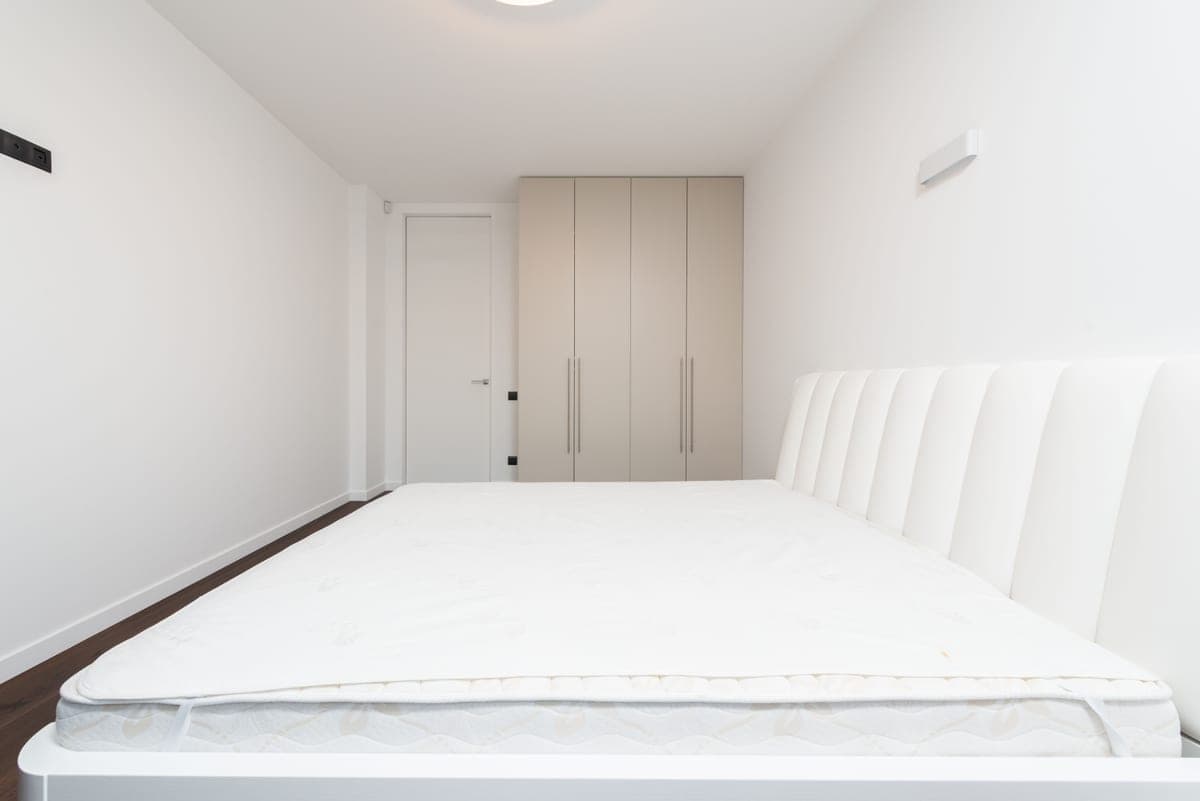
A plain mattress on a simple white bed frameIllustrative

DHP 8 Inch Independently Encased Coil Futon Mattress

Eight inches with 15-gauge pocket coils — the closest a drop-in futon mattress gets to a real bed, and it fits any standard full futon frame.

Everyday sleeping on a futon frame8.1
Check price on Amazon

#ad how we earn · we do not print prices

02
A small guest bedroom with a neatly made bed against a pale wallIllustrative

Zinus 8 Inch Green Tea Memory Foam Mattress

Two inches of memory foam, two of comfort foam, four of base — the standard answer for a daybed or trundle that needs a real mattress under 10 inches.

Daybeds and trundles8.0
Check price on Amazon

#ad how we earn · we do not print prices

03
A low bedroom with wooden flooring and a sliding glass door, laid out for a floor mattressIllustrative

MAXYOYO Padded Japanese Floor Futon Mattress

Four inches, 10 to 14.5 lb depending on size, and it rolls up. The smallest-footprint guest bed there is, because when it is away it has no footprint at all.

Occasional guests with nowhere to put a bed7.4
Check price on Amazon

#ad how we earn · we do not print prices

How we picked

The three products here map onto the three formats the page addresses — a bi-fold frame, a non-folding frame, and the floor — because the right fix depends entirely on which you have. Ranked by depth, since depth is the variable that decides comfort in this category.

Everyday sleeping on a futon frame

DHP 8 Inch Independently Encased Coil Futon Mattress

DHP
A plain mattress on a simple white bed frameIllustrative — category photo, not this unit

Eight inches with 15-gauge pocket coils — the closest a drop-in futon mattress gets to a real bed, and it fits any standard full futon frame.

What it's bad at

59 lb of mattress on a frame that has to fold. It is stiff to bi-fold the first dozen times, and a light frame will feel the weight.

Our score — 8.1 / 10

Comfort8
Depth9
Foldability6
Weight5
Value8
Check price on Amazon →

#ad how we earn · we do not print prices

Specifications

Folded footprint
Ships rolled: 59 in. L x 13 in. W x 13 in. H carton
Open footprint
75 in. L x 54 in. W x 8 in. H (full)
Clearance in front
Not applicable — this is a mattress, not a frame.
Doorway minimum
Passes any standard doorway in the shipping carton (13 in. square section)
Sleep surface
75 x 54 in. — standard full
Mattress
8 in.; 15-gauge independently encased pocket coils with foam and polyester layers
Fold mechanism
Bi-folds with the frame
Weight capacity
NOT STATED BY MANUFACTURER
Assembly
None. 59 lb net, 71 lb shipped.
Renter-safe?
Yes
Price
Check price on Amazon

Source: Brand listing via Walmart.com and Amazon.com product pages, recorded 27 Sep 2026. Any field the listing does not state is marked as such rather than estimated.


Daybeds and trundles

Zinus 8 Inch Green Tea Memory Foam Mattress

Zinus

A small guest bedroom with a neatly made bed against a pale wallIllustrative — category photo, not this unit

Two inches of memory foam, two of comfort foam, four of base — the standard answer for a daybed or trundle that needs a real mattress under 10 inches.

What it's bad at

The twin is rated to 250 lb where every other size is 500 lb, which matters because twin is exactly the size daybeds take.

Our score — 8.0 / 10

Comfort8
Depth7
Foldability1
Weight6
Value9
Check price on Amazon →

#ad how we earn · we do not print prices

Specifications

Folded footprint
Ships compressed and rolled in a box
Open footprint
Standard mattress sizes, 8 in. deep
Clearance in front
Not applicable — mattress.
Doorway minimum
Ships rolled, so any doorway
Sleep surface
Standard Twin through King
Mattress
8 in.; 2 in. memory foam + 2 in. airflow comfort foam + 4 in. high-density base
Fold mechanism
None — does not fold
Weight capacity
250 lb in Twin; 500 lb in all other sizes
Assembly
None. Expands in a few hours, settles within 48.
Renter-safe?
Yes
Price
Check price on Amazon

Source: Manufacturer listing, zinus.com, plus the Amazon.com product page, recorded 27 Sep 2026. Any field the listing does not state is marked as such rather than estimated.

Occasional guests with nowhere to put a bed

MAXYOYO Padded Japanese Floor Futon Mattress

MAXYOYO

A low bedroom with wooden flooring and a sliding glass door, laid out for a floor mattressIllustrative — category photo, not this unit

Four inches, 10 to 14.5 lb depending on size, and it rolls up. The smallest-footprint guest bed there is, because when it is away it has no footprint at all.

What it's bad at

Four inches on a hard floor is four inches. Side sleepers and anyone over about 200 lb will feel the floor, and it has to be aired or it holds moisture.

Our score — 7.4 / 10

Comfort5
Depth4
Foldability10
Weight10
Value9
Check price on Amazon →

#ad how we earn · we do not print prices

Specifications

Folded footprint
Rolls up; rolled dimensions not stated
Open footprint
Twin 39 x 80 in.; Full 54 x 80 in.; Queen 60 x 80 in.; King 78 x 80 in. — all 4 in. thick
Clearance in front
Not applicable — floor mattress.
Doorway minimum
Rolled, passes any doorway
Sleep surface
Full mattress widths at 80 in. long
Mattress
4 in. quilted; microfiber cotton over high-density foam. Also sold in 4.5, 6 and 8 in.
Fold mechanism
Roll-up / fold
Weight capacity
NOT STATED BY MANUFACTURER
Assembly
None. Twin 10 lb, Full 13 lb, Queen 14.5 lb, King 22 lb.
Renter-safe?
Yes
Price
Check price on Amazon

Source: Manufacturer listing, maxyoyohome.com, recorded 27 Sep 2026. Any field the listing does not state is marked as such rather than estimated.

Answers

Common questions

How do you make a futon more comfortable to sleep on?
Add depth first — a topper of at least three inches, or better, replace the mattress with eight inches of encased pocket coil on a bi-fold frame. Then close the slat gaps with a bunkie board or thin plywood, which removes the sag nobody mentions. On a floor futon, get it onto a slatted base so it is not trapping moisture.
Will a mattress topper fix a futon?
If it is at least three inches thick, yes, meaningfully. Under three inches you are buying a texture change rather than support, especially on a mattress whose comfort layer has already compressed. On a convertible futon sofa a topper helps much less, because the problem there is a structural fold seam.
Should you put plywood under a futon mattress?
On a slatted futon frame, yes — a bunkie board or thin plywood closes the slat gaps and stops a thin mattress sagging between them. It is one of the cheapest real improvements available. Do not do it on a fold-out sofa bed, where it stops the mattress folding.
How often should you rotate a futon mattress?
Every month or two, end to end. Foam compresses permanently where the weight is, and rotating spreads it. Only flip it if the mattress is genuinely double-sided — most modern futon mattresses have their comfort layers on one side and a label saying so.
Do you need a mat under a Japanese floor futon?
If it stays down for more than a night or two, yes. A floor futon traps moisture against the floor, and the traditional answer is airing it daily. A slatted roll-up base or breathable mat achieves the same thing and also raises the surface an inch or two, which helps with getting up.

Sources

Keep reading