

Skip to content

Guides / Comparison

Futon vs Mattress

A futon mattress is a mattress with one extra requirement imposed on it: it has to bend. Everything people dislike about futons traces back to that single constraint.

A plain mattress on a simple white bed frame in a quiet room

The difference is one requirement: a futon mattress has to fold and a bed mattress does not. At eight inches of depth, our best futon mattress and our best compact bed mattress are remarkably close in construction — the gap opens up at everything the fold forces.

So the real question is not which is more comfortable at a given depth. It is whether you need the folding at all. If the frame has to convert between sofa and bed, you need a futon mattress and there is no argument. If the frame is a daybed, a trundle or a wall bed, you can buy an ordinary mattress and you should.

At the same depth, side by side

An 8-inch futon mattress against an 8-inch bed mattress

DHP 8 in. futon mattress
15-gauge independently encased pocket coils, foam layers
Zinus 8 in. Green Tea
2 in. memory foam + 2 in. comfort foam + 4 in. base
DHP sleeping surface
75 × 54 in. — standard full
Zinus sleeping surface
Standard Twin through King
DHP folds
Bi-folds with the frame
Zinus folds
Does not fold at all
DHP weight
59 lb net, 71 lb shipped
Zinus published capacity
250 lb in Twin; 500 lb in all other sizes
DHP published capacity
Not stated by the manufacturer

Two things to take from that. The first is that the futon mattress is not the inferior product it is assumed to be: 15-gauge pocket coils that compress locally is arguably a better construction for a side sleeper than a foam slab of the same depth, and the DHP is as deep as the Zinus.

The second is the weight. Fifty-nine pounds of mattress on a frame that has to fold is a lot, and it is the first-order cost of the fold requirement. It is stiff to bi-fold the first dozen times, and a light tube-steel frame will feel it.

What the fold requirement actually costs

A permanent crease. A mattress that bends has a hinge line, and over time the hinge line is findable. Nobody publishes how long that takes and we will not estimate it, but the failure mode is structural rather than cosmetic.

Depth ceilings on the frame. Folding frames cap mattress depth because the folded assembly has to close. That is why daybeds publish an 8-inch maximum — the Novogratz Bushwick does, and so does the Dream Solutions pop-up trundle — and why there is no 12-inch futon mattress for a convertible frame.

Size naming that does not match a bed. A futon mattress is full-size at 75 by 54 inches, which is a standard full, so that one is honest. Sofa beds are where this goes wrong: a sofa-bed queen mattress is 58 by 72 inches rather than 60 by 80, so your sheets do not fit. The reference is in sleeper sofa mattress sizes.

No published capacity, usually. The DHP futon mattress states none, where the Zinus states 250 lb in twin and 500 in larger sizes. In fairness this is a mattress-industry convention rather than a futon failing, but it is a real information gap.

The third answer, which is what most people are really asking

A good share of “futon vs mattress” searches are really about the Japanese sense of the word: a mattress on the floor rather than a mattress on a folding sofa frame. That is a genuinely different comparison.

A MAXYOYO floor futon is 4 inches of quilted microfiber-cotton over high-density foam, 10 to 14.5 lb depending on size, in Twin 39 by 80 up to King 78 by 80 — full mattress widths at a proper 80 inches of length, which almost nothing else on this site manages. It rolls away to nothing, which means for 355 nights a year it occupies no floor at all.

What it gives up is depth. Four inches on a hard floor is four inches, and the manufacturer is straight that side sleepers and anybody much over 200 lb will feel the floor through it. It also has to be aired or it holds moisture, which is not a drawback a bed mattress has. MAXYOYO sells the same mattress in 4.5, 6 and 8 inch versions, and the 8-inch is a materially different product for an adult. The format is covered in the best Japanese floor futons.

Is a futon worse for your back than a mattress?

Not inherently, and the research base that gets cited for firm-is-better is weaker than the internet suggests. What is true is that depth and local compression matter: an 8-inch pocket-coil futon mattress supports a hip the way a 4-inch pad on a hard floor cannot. The fuller discussion is in is sleeping on a futon bad for you.

The verdict, by frame

Your frame folds: buy a futon mattress, as deep as the frame allows, and buy coils rather than foam if you sleep on your side. There is no choice to agonise over — a non-folding mattress on a folding frame will not close.

Your frame is a daybed, a trundle or a wall bed: buy an ordinary mattress. Nothing is gained by a folding mattress on a frame that does not fold, and you give up depth and capacity for nothing. Check the frame’s published ceiling first — 8 inches on most daybeds, 8 to 12 inches on Bestar’s queen wall beds.

There is no frame and there will not be one: a floor futon, bought at 6 or 8 inches rather than 4 if an adult is sleeping on it nightly.

You are deciding between formats rather than mattresses: futon vs sofa bed covers the frames, and the best futon mattresses for everyday sleeping is the shortlist if a futon is going to be somebody’s actual bed.

Some links on this page are affiliate links. If you buy through one we may earn a commission at no extra cost to you, and it does not change what we recommend or how we rank it. Full disclosure.

At a glance

What we would buy on either side

Tap any row to jump to the full write-up. Scores are our own, from the rubric on how we choose — not customer ratings. They score each product across the whole site, so the order here reflects how well a pick answers this page’s question, which is not always the same as the highest score.

#ProductBest forScorePrice
01
A plain mattress on a simple white bed frameIllustrative

DHP 8 Inch Independently Encased Coil Futon Mattress

Eight inches with 15-gauge pocket coils — the closest a drop-in futon mattress gets to a real bed, and it fits any standard full futon frame.

Everyday sleeping on a futon frame8.1
Check price on Amazon

#ad how we earn · we do not print prices

02
A small guest bedroom with a neatly made bed against a pale wallIllustrative

Zinus 8 Inch Green Tea Memory Foam Mattress

Two inches of memory foam, two of comfort foam, four of base — the standard answer for a daybed or trundle that needs a real mattress under 10 inches.

Daybeds and trundles8.0
Check price on Amazon

#ad how we earn · we do not print prices

03
A low bedroom with wooden flooring and a sliding glass door, laid out for a floor mattressIllustrative

MAXYOYO Padded Japanese Floor Futon Mattress

Four inches, 10 to 14.5 lb depending on size, and it rolls up. The smallest-footprint guest bed there is, because when it is away it has no footprint at all.

Occasional guests with nowhere to put a bed7.4
Check price on Amazon

#ad how we earn · we do not print prices

How we picked

One pick per answer rather than a ranking: the deepest futon mattress we cover that still bi-folds, the standard non-folding mattress that a daybed or wall bed would take instead, and the floor futon that represents the third option people are usually really asking about. Construction and depth are quoted from the manufacturer's listing; no comparative durability claim is made because nobody in either category publishes a lifespan.

Everyday sleeping on a futon frame

DHP 8 Inch Independently Encased Coil Futon Mattress

DHP
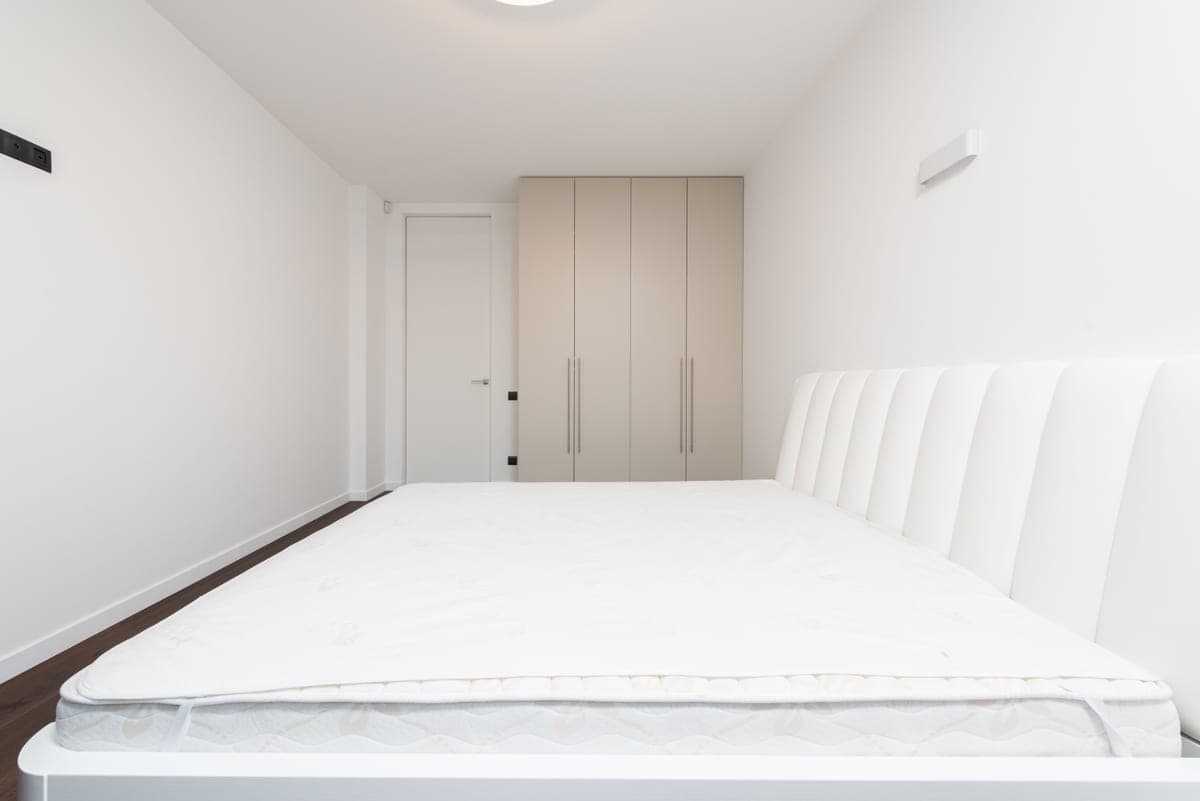
A plain mattress on a simple white bed frameIllustrative — category photo, not this unit

Eight inches with 15-gauge pocket coils — the closest a drop-in futon mattress gets to a real bed, and it fits any standard full futon frame.

What it's bad at

59 lb of mattress on a frame that has to fold. It is stiff to bi-fold the first dozen times, and a light frame will feel the weight.

Our score — 8.1 / 10

Comfort8
Depth9
Foldability6
Weight5
Value8
Check price on Amazon →

#ad how we earn · we do not print prices

Specifications

Folded footprint
Ships rolled: 59 in. L x 13 in. W x 13 in. H carton
Open footprint
75 in. L x 54 in. W x 8 in. H (full)
Clearance in front
Not applicable — this is a mattress, not a frame.
Doorway minimum
Passes any standard doorway in the shipping carton (13 in. square section)
Sleep surface
75 x 54 in. — standard full
Mattress
8 in.; 15-gauge independently encased pocket coils with foam and polyester layers
Fold mechanism
Bi-folds with the frame
Weight capacity
NOT STATED BY MANUFACTURER
Assembly
None. 59 lb net, 71 lb shipped.
Renter-safe?
Yes
Price
Check price on Amazon

Source: Brand listing via Walmart.com and Amazon.com product pages, recorded 27 Sep 2026. Any field the listing does not state is marked as such rather than estimated.


Daybeds and trundles

Zinus 8 Inch Green Tea Memory Foam Mattress

Zinus

A small guest bedroom with a neatly made bed against a pale wallIllustrative — category photo, not this unit

Two inches of memory foam, two of comfort foam, four of base — the standard answer for a daybed or trundle that needs a real mattress under 10 inches.

What it's bad at

The twin is rated to 250 lb where every other size is 500 lb, which matters because twin is exactly the size daybeds take.

Our score — 8.0 / 10

Comfort8
Depth7
Foldability1
Weight6
Value9
Check price on Amazon →

#ad how we earn · we do not print prices

Specifications

Folded footprint
Ships compressed and rolled in a box
Open footprint
Standard mattress sizes, 8 in. deep
Clearance in front
Not applicable — mattress.
Doorway minimum
Ships rolled, so any doorway
Sleep surface
Standard Twin through King
Mattress
8 in.; 2 in. memory foam + 2 in. airflow comfort foam + 4 in. high-density base
Fold mechanism
None — does not fold
Weight capacity
250 lb in Twin; 500 lb in all other sizes
Assembly
None. Expands in a few hours, settles within 48.
Renter-safe?
Yes
Price
Check price on Amazon

Source: Manufacturer listing, zinus.com, plus the Amazon.com product page, recorded 27 Sep 2026. Any field the listing does not state is marked as such rather than estimated.

Occasional guests with nowhere to put a bed

MAXYOYO Padded Japanese Floor Futon Mattress

MAXYOYO

A low bedroom with wooden flooring and a sliding glass door, laid out for a floor mattressIllustrative — category photo, not this unit

Four inches, 10 to 14.5 lb depending on size, and it rolls up. The smallest-footprint guest bed there is, because when it is away it has no footprint at all.

What it's bad at

Four inches on a hard floor is four inches. Side sleepers and anyone over about 200 lb will feel the floor, and it has to be aired or it holds moisture.

Our score — 7.4 / 10

Comfort5
Depth4
Foldability10
Weight10
Value9
Check price on Amazon →

#ad how we earn · we do not print prices

Specifications

Folded footprint
Rolls up; rolled dimensions not stated
Open footprint
Twin 39 x 80 in.; Full 54 x 80 in.; Queen 60 x 80 in.; King 78 x 80 in. — all 4 in. thick
Clearance in front
Not applicable — floor mattress.
Doorway minimum
Rolled, passes any doorway
Sleep surface
Full mattress widths at 80 in. long
Mattress
4 in. quilted; microfiber cotton over high-density foam. Also sold in 4.5, 6 and 8 in.
Fold mechanism
Roll-up / fold
Weight capacity
NOT STATED BY MANUFACTURER
Assembly
None. Twin 10 lb, Full 13 lb, Queen 14.5 lb, King 22 lb.
Renter-safe?
Yes
Price
Check price on Amazon

Source: Manufacturer listing, maxyoyohome.com, recorded 27 Sep 2026. Any field the listing does not state is marked as such rather than estimated.

Answers

Common questions

Is a futon mattress as good as a regular mattress?
At the same depth they are closer than people assume. Our 8-inch futon mattress uses 15-gauge independently encased pocket coils, which compress locally under a hip, against an 8-inch bed mattress built as two inches of memory foam over two of comfort foam over a four-inch base. The futon's real costs are weight - 59 lb because it has to fold - and the crease that a folding mattress eventually develops.
Is it better to sleep on a futon or a mattress?
On a frame that folds, a futon mattress, because a non-folding mattress will not close into the frame. On a daybed, a trundle or a wall bed, an ordinary mattress - you gain depth and a published weight capacity and give up nothing, since the folding ability buys you nothing on a frame that does not fold.
Why are futon mattresses thinner than bed mattresses?
Because the frame caps them. A folding assembly has to close, so folding frames publish a maximum mattress depth - 8 inches on the Novogratz Bushwick daybed and the Dream Solutions pop-up trundle, for example. That is why there is no 12-inch futon mattress for a convertible frame, where a wall bed will happily take 8 to 12 inches.
Can you put a regular mattress on a futon frame?
Not on a frame that has to fold - it will not bend and the frame will not close. On a daybed or trundle frame, which does not fold, a standard mattress is the better buy as long as it is inside the frame's stated depth ceiling. Wall beds are the most generous: Bestar's queens take 8 to 12 inches at 60 to 90 lb and explicitly exclude futons.
What is the difference between a futon and a Japanese futon?
In American usage a futon is a folding mattress on a convertible sofa frame; in Japanese usage it is a thin mattress laid directly on the floor and rolled away each morning. The floor version comes in full mattress widths at a proper 80 inches of length and weighs 10 to 14.5 lb, but the standard depth is 4 inches, which is not enough for a side sleeper on a hard floor.

Sources

Keep reading